
Get Daily Founder Insights
Short, practical strategies to grow your business — delivered daily.
Subscribe Now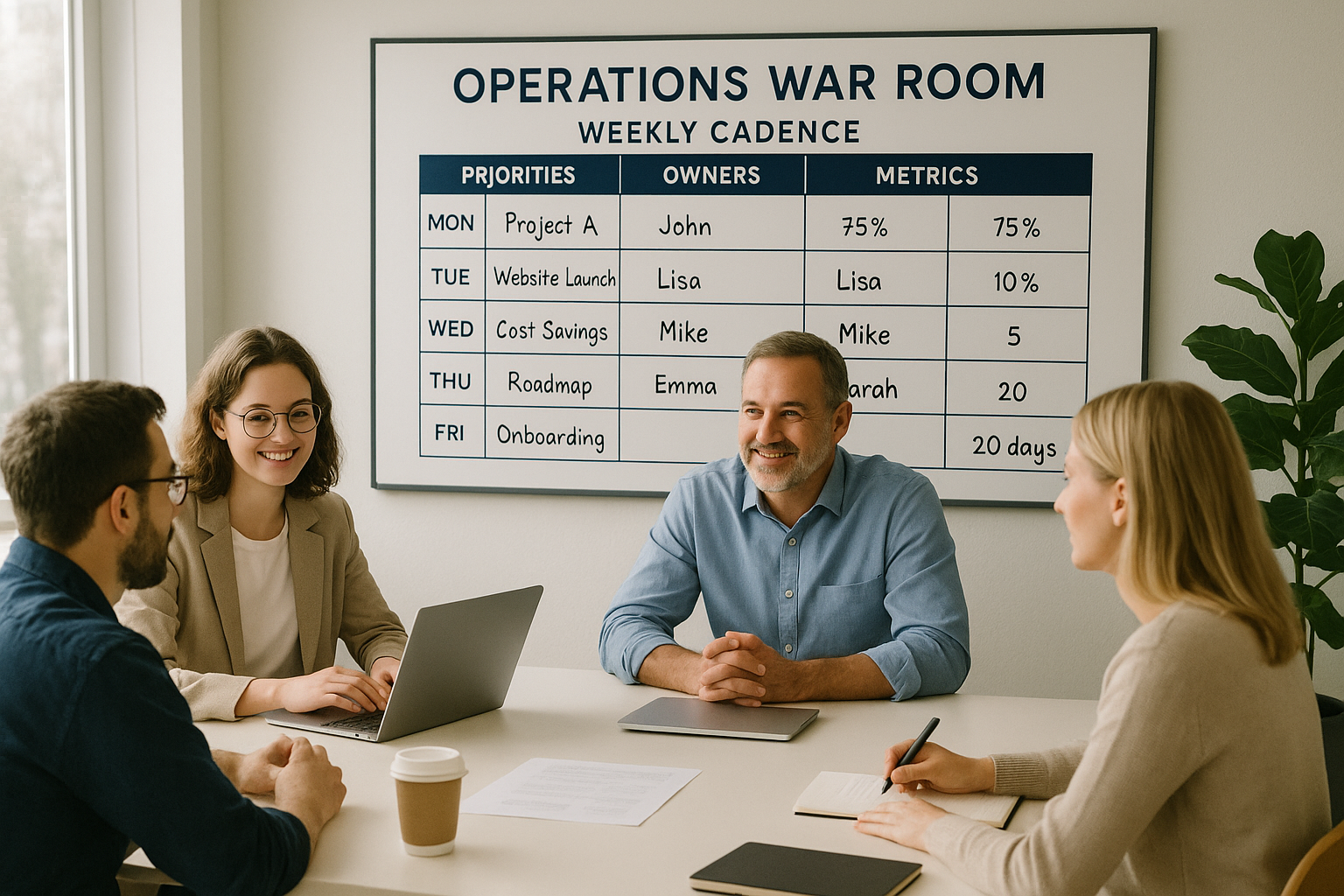
Design rhythms, roles, and norms that let you scale without burning out.
Build a weekly operating rhythm that creates calm and accountability
Calm isn’t the opposite of growth—it’s the precondition. Companies that scale sustainably operate on a clear weekly rhythm that turns priorities into shipped outcomes without grinding down their leaders. Start with a simple cadence. On Monday, hold a 45‑minute leadership sync focused on last week’s outcomes and the top three priorities for the week ahead. Use a single page—goals, owners, blockers, and due dates—to concentrate attention. Tuesday through Thursday, protect two daily 90‑minute deep‑work blocks per leader; no meetings, no Slack. Daily standups stay under 10 minutes and focus on flow: what moved, what’s stuck, and what decisions are needed. On Friday, run a demo and decide session where teams show progress and surface two decisions leadership must make. This rhythm reduces status theater and sifts noise from signal. Limit work‑in‑progress. Most overwhelm is the result of too many simultaneous initiatives and unclear definitions of “ready” and “done.” Cap each team at two or three active projects. Define “ready” as scoped, sized, and scheduled; define “done” as accepted by the requester and documented. You’ll see cycle times tighten and morale improve. Make plans visible. A shared tracker that covers no more than a single page per team keeps focus crisp. Metrics should be few and behavior‑shaping: cycle time by project, blocked items older than 72 hours, and the count of decisions awaiting leadership. For guidance on building the foundations of a scalable operating system, the U.S. Small Business Administration offers practical, plain‑English resources: SBA: Grow Your Business.
Clarify decision rights, handoffs, and capacity to reduce friction
Frictions that burn leaders out are often structural: fuzzy decision rights, messy handoffs, and invisible capacity. Start by mapping your 10 most common decision types—pricing changes, enterprise discounts, hiring approvals, vendor selection, roadmap shifts—and publishing a simple RAPID or RACI for each. Clarity about who recommends, who decides, and who must be consulted cuts escalation load and speeds outcomes. Pair that with explicit service-level expectations: how quickly issues are triaged, when something escalates, and what “good” looks like. Fix handoffs with checklists and single‑owner accountability. Every cross‑functional project should have one accountable owner, even if many contribute. Use checklists to standardize recurring processes—launches, hiring, onboarding, vendor onboarding—and attach templates to reduce rework. When in doubt, shorten the loop: move complex discussions to written one‑pagers that articulate the problem, options, tradeoffs, and a recommended decision. You’ll battle confusion before it grows into conflict. Capacity is a constraint, not a variable. Track planned vs. actual capacity by team and guardrails for after‑hours work. Leaders who routinely overdraw their energy pay it back with interest in the form of slower thinking and brittle culture. Keep a simple scoreboard: percentage of projects completed on time, average cycle time for decisions, and the number of escalations per week. If escalations spike, you’re under‑specifying decision rights or overloading key people. For patterns and practices that reduce executive isolation—a major driver of burnout—see this overview from Harvard Business Review: HBR: Overcome Executive Isolation.
Shape culture and support systems that sustain leaders at scale
Sustained performance depends on culture and support systems that protect leader energy. Codify norms that make calm the default. Examples: two no‑meeting windows per day for deep work; a shared rule to avoid same‑day meeting adds unless critical; and a monthly “Stop Doing” review to prune work that no longer serves priorities. Train managers to coach, not just delegate. Coaching behaviors—asking catalytic questions, clarifying outcomes, and creating accountability—reduce founder dependency and build distributed judgment. Invest in a small council of truth‑tellers: a seasoned operator outside your company, a peer CEO, a customer, and a coach. Meet monthly to pressure‑test strategy, trade notes on team health, and share playbooks. Outside perspective counters internal echo chambers and reduces the cognitive load of carrying the business alone. Augment with a structured learning community so your leadership team has access to on‑demand modules, weekly group coaching, and a 24/7 forum for roadblocks. The Lonely Entrepreneur Learning Community makes this support turnkey, with 500+ modules and tools you can drop straight into your cadence: TLE Learning Community. Finally, track the few metrics that signal sustainable scale: rework cycles on major decisions trending down; time‑to‑clarity on strategic forks shrinking; and team climate scores improving. For additional pro bono guidance, experienced mentors at SCORE can help you sanity‑check operating changes: SCORE: Find a mentor. Calm companies aren’t slow—they’re precise. The result is more shipped work, fewer emergencies, and leaders who last.
