
Get Daily Founder Insights
Short, practical strategies to grow your business — delivered daily.
Subscribe Now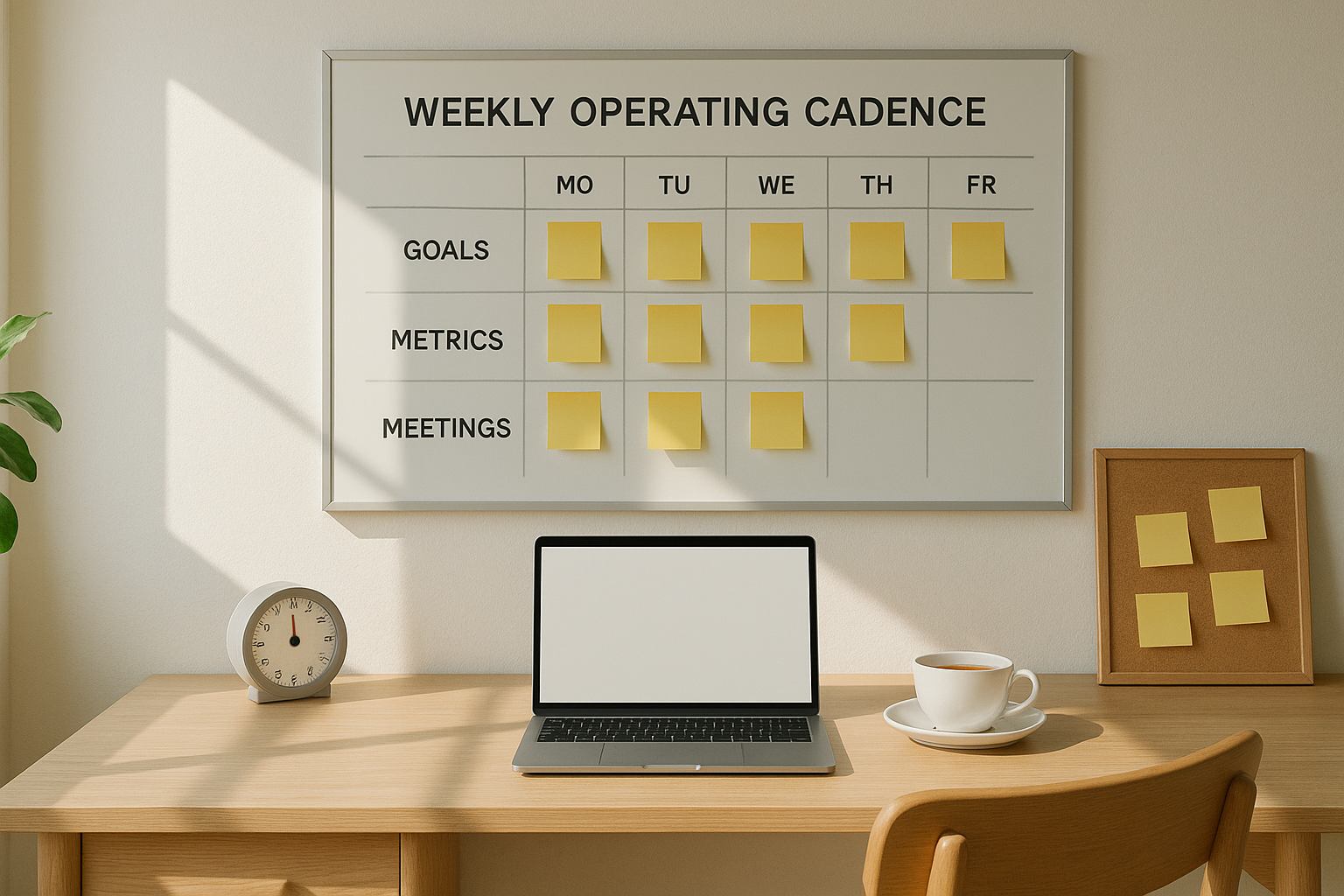
A simple weekly operating system to cut overwhelm and create calm, repeatable scale.
Diagnose overwhelm: signals, sources, and hidden costs
Overwhelm isn’t just a feeling—it’s a system outcome. When founders report “too many fires,” what’s usually underneath is decision friction (unclear priorities), calendar debt (meetings without outcomes), and work-in-progress sprawl (too much started, not enough finished). The signals show up in subtle ways: you rewrite priorities every week, key projects stall for lack of definition, and you’re pinged about everything because no one is sure what “done” looks like. The costs are real. Context switching can vaporize 20–40% of productive time. Constant urgency crowds out deep work and turns your leadership voice staccato. It also creates learned helplessness in teams: when the founder is the bottleneck, initiative withers. Before you can scale, you have to turn the noise down and replace it with a repeatable operating rhythm. Start by mapping sources of overwhelm across three lanes—strategy, operations, and personal energy. Strategy overload sounds like “too many bets” and can be tamed by a simple rule: three strategic priorities per quarter, each with a clear owner and a measurable outcome. Operational chaos usually traces to unclear handoffs and invisible work; it recedes when you limit work-in-progress and make commitments visible in one shared tracker. Personal energy debt often hides behind heroics; if every urgent issue routes to you, you aren’t leading at the right altitude. Treat this diagnosis as the baseline—you’re not fixing you, you’re fixing the system that produces overwhelm.
Install a weekly operating cadence that reduces chaos fast
A founder-friendly operating cadence can calm the chaos in two weeks. Here’s a minimal version that works for companies from five to 150 people. Monday: priorities and capacity. In a 45‑minute leadership sync, review last week’s outcomes, set the top three priorities for each team, and confirm capacity. Use a single page: goals, owners, blockers, and due dates. Tuesday–Thursday: run the machine. Daily 10‑minute standups keep work flowing; anything bigger goes to a separate problem‑solving session. Protect two 90‑minute focus blocks per day—no meetings, no Slack. Friday: demo and decide. Teams show the week’s progress and surface two decisions leadership must make. This cadence replaces status theater with outcomes and turns “What are we doing?” into “What did we ship?” To support it, clarify definitions. “Ready” means scoped, sized, and scheduled. “Done” means accepted by the requester and documented. Reducing work‑in‑progress is non‑negotiable: limit teams to two or three active projects each. Finally, implement a weekly retro (15 minutes) to ask: What drained energy? What created momentum? What will we change next week? For inspiration on building systematic growth habits, explore the SBA’s proven guidance on scaling and operational discipline at SBA: Grow Your Business. A rhythm like this makes overwhelm visible, negotiable, and fixable—fast.
Keep it calm: tools, automation, and support that scale
Keeping calm as you scale requires two things: leverage and support. First, put your tools to work. Use lightweight automation to move work forward without meetings: intake forms route requests to a shared board; templates convert chaos into consistent outputs; and checklists prevent rework. Second, decide what you won’t do. Codify a “Stop Doing” list (projects, meeting types, and reports) and revisit it monthly. Third, invest in support that multiplies you. A coach helps you operate at the right altitude, and a structured community provides playbooks and peer accountability. Consider a platform that combines on‑demand learning, weekly group coaching, and a 24/7 forum so you never get stuck on the same issue for long. The Lonely Entrepreneur Learning Community offers exactly that mix, with 500+ modules and tools you can plug into your cadence: TLE Learning Community. Fourth, build a personal energy dashboard. Track sleep consistency, deep work hours, and “reactivity spikes” (when you abandon the plan) to spot patterns before they become problems. Fifth, get outside help when appropriate. Free, expert mentoring can tilt the odds in your favor; find experienced mentors who have solved your exact problem at SCORE: Find a mentor. As these systems take root, notice the shift: fewer emergencies, faster cycle times, and a team that advances work without you in every room. That’s what calm scale feels like—boring in the best possible way.
